
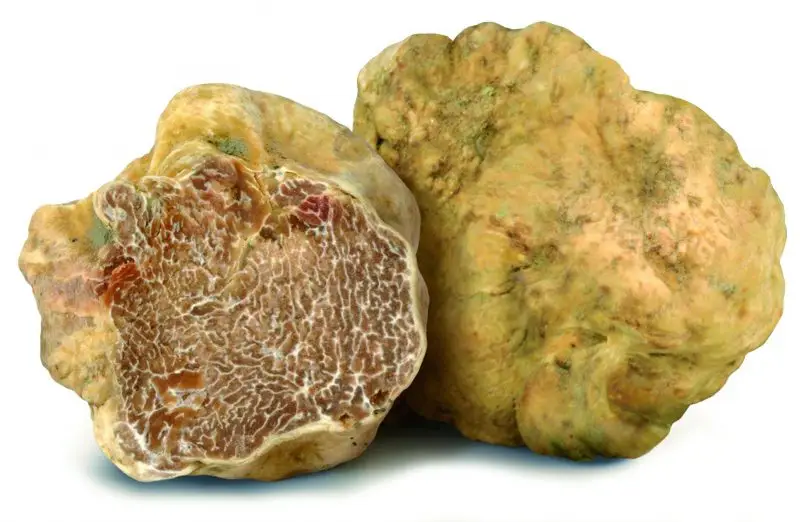
Lhe white truffle (Tuber magnatum), often referred to as the "white diamond", is one of the world's most prized and expensive truffles. Its rarity, unique aroma and culinary properties make it an ingredient of choice in haute cuisine. This article explores the global production of the
white truffle, where it comes from, the challenges posed by global warming, the importance of soil structure and its economic impact.
Overview of world production and origin
White truffles are mainly grown in southeastern Europe, with Italy, particularly the Piedmont and Tuscany regions, being the main producer. However, a recent meta-study showed that 75% of white truffle sites are located outside the traditional harvesting region of Piedmont, i.e. outside Alba. These sites cover a wide geographical range from western Switzerland to eastern Bugaria and between Sicily and Hungary, with altitudes between sea level and 1,000 meters. The sites extend from Sicily (~37°N) to Hungary (~47°N).
In addition, it has been shown that Tuber magnatum rarely grows far from Europe except at a site in northern Thailand at ~18° N, which is probably the southernmost limit of its global range (Suwannarach et al. 2017) : The white truffle was first found in Doi Stuhep-Pui National Park by the Biology Department of Chiang Mai University in 2014.
Named Tuber thaïlandeicum, it was later given the common name Thepsukhon white truffle by Her Royal Highness Princess Maha. In 2015, the research team discovered another new species, Tuber lannaense. But in their latest research, the team successfully found and cultivated Tuber magnatum, or the Italian white truffle, which is the most expensive truffle in the world with a price tag of 160,000 baht per kilogram (€4,000).
According to the research team, not only does this discovery challenge all theories suggesting that truffles are not found in tropical regions, it could also help boost the country's economy. The research team is currently investigating the possibilities of developing a truffle farm in Thailand.
In Switzerland, white truffle cultivation is still in its infancy and testing phase, but Swiss truffle growers are beginning to explore the potential of this precious truffle. Although Swiss production is modest compared to that of Italy, it represents an opportunity for agricultural diversification and to enhance the value of the Swiss terroir.
Distribution of 231 white truffle sites (green dots), including ~ 25% in the traditional Piedmont region of Italy (dark red dots). Only sites where fruiting bodies have been confirmed in the literature are included. One site has also been reported in Thailand (Suwannarach et al. 2017), but is not shown in the figure.
Source : Sustainable cultivation of the white truffle (Tuber magnatum) requires ecological understanding - Article in Mycorrhiza - July 2023
The challenges of global warming
Global warming poses major challenges to white truffle production. Changes in temperature, irregular rainfall and extreme conditions directly affect the quality and quantity of truffles produced.
White truffles require moderately cold winters and temperate summers. Average winter temperatures above 0.4°C and summers without excessive heat are crucial. With global warming, these conditions are becoming increasingly rare. In addition, summer rainfall of around 50 mm is ideal. Changes in rainfall patterns, with periods of drought followed by heavy rainfall, disrupt the truffle development cycle. The increase in extreme weather events contributes to soil erosion and degradation, affecting its ability to support truffle cultivation.
The importance of soil structure
White truffles thrive in nutrient-rich, well-drained clay-limestone soils with a pH ranging from 6.4 to 8.7. Soil structure plays a crucial role in truffle growth. Soils on white truffle sites generally contain more clay (>20%) and are often formed by flooding or landslides. They must also have good macroporosity to allow adequate aeration and root penetration. A cation exchange capacity of around 17 meq/100 g is ideal for supplying the nutrients truffles need. In some cases, soils need to be amended to correct pH and improve structure, for example by adding lime.
At least 26 potential host species belonging to 12 genera have been identified, with Populus alba and Quercus cerris accounting for 23.5% of all plant species. The white truffle can tolerate a wide range of pH and soil types, potentially enabling its cultivation outside its natural range.
Important for humans, but what if it's just as important for truffles? The Microbiome:
- The truffle microbiome refers to all the micro-organisms (bacteria, fungi, viruses, etc.) that live in association with the truffle, both inside and outside it. This microbiome plays a crucial role in the growth, health and development of the truffle.
- The truffle microbiome is made up of a variety of micro-organisms, including bacteria that colonize the surface and interior of truffles, helping to break down organic matter, providing nutrients and playing a role in symbiotic interactions with host plants. Mycorrhizal fungi form mycorrhizal symbioses with the roots of host plants, helping to absorb nutrients, particularly phosphorus. Other fungal species may also be present and influence truffle health and growth.
- Soil micro-organisms and those present on truffles contribute to the decomposition of organic matter, releasing essential nutrients for truffle growth. Truffles form mycorrhizae with the roots of certain host plants, improving water and nutrient uptake, which is crucial for truffle survival in harsh environments. Certain micro-organisms present on truffles can protect against pathogens by producing antimicrobial substances or occupying ecological niches, thus preventing the establishment of pathogens.
- Bacteria and other micro-organisms present in the truffle microbiome can influence its characteristic aroma by breaking down organic compounds and producing unique volatile compounds. Microbial composition can affect truffle quality and shelf-life. A balanced microbiome can prevent rapid degradation and contamination by pathogens.
- Soil conditions, climate and farming practices influence the composition of the truffle microbiome. Different types of truffle (e.g. Tuber melanosporum, Tuber magnatum) can have distinct microbiomes. Host plant species and their state of health can also modulate truffle microbiome composition.
And finally, a few words about the economic impact:
Worldwide demand for white truffles continues to grow, fuelled by high-end gastronomy and renowned chefs. In truffle-growing regions, truffle production represents a major source of income for farmers and local communities. It is valued at 400 million in Italy and 900 million in Europe. It also contributes to gastronomic tourism, attracting visitors eager to discover and taste this precious mushroom. However, fluctuations in production due to variable weather conditions create economic uncertainty. Growers need to invest in sustainable technologies and management practices to maintain their yields. Will new crops brought on by global warming cause Magnatum prices to plummet when supply rises sharply? Many questions to which time will provide the answer.