
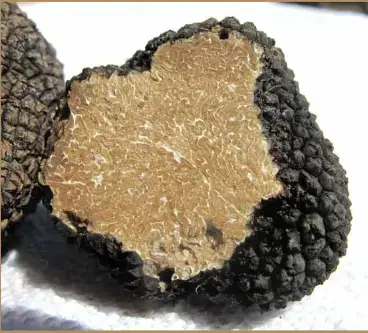
🌳🌿 The summer truffle is a type of truffle widely distributed in Europe. Despite its lesser popularity compared to the Périgord black truffle or the Alba white truffle, the summer truffle possesses some unique characteristics . This article offers a detailed exploration of the summer truffle, from its habitat to its use in cooking. 🌳🌿
The summer truffle is distinguished by its black, warty skin and inner flesh that varies from beige to light brown, streaked with white veins. Its aroma is light and delicate, often described as reminiscent of hazelnuts and fresh mushrooms. This subtlety makes the summer truffle an ingredient appreciated for its ability to add depth to dishes without overpowering the flavors.
🖤🍄 Habitat and Growth Conditions
The summer truffle thrives in a variety of soils, but prefers slightly alkaline calcareous soils, with an ideal pH of around 7.3 to 7.5. It is often associated with trees such as oak, hazelnut, beech and lime. This truffle is particularly hardy and can adapt to drier, warmer conditions, making it less demanding in terms of soil and climate conditions than other truffle varieties.
🕰️👩🌾 Life Cycle and Harvesting
The summer truffle is harvested from May to September, hence its name. They are generally found close to the surface of the soil, making them easy to harvest.
🍽️👨🍳 Culinary use
Because of its lighter aroma, summer truffles are often used in dishes where a subtle flavor is desired. It can be grated onto salads, pastas and risottos, or used to infuse oils and butters. Here are a few recipe ideas for enjoying summer truffles to the full:
- Summer Truffle Salad: Grate thin slices of summer truffle over an arugula and Parmesan salad, drizzled with a light vinaigrette.
- Summer Truffle Pasta: Add strips of summer truffle to a fresh pasta dish with a creamy Parmesan sauce.
- Summer Truffle Scrambled Eggs: Add grated truffles to scrambled eggs for a refined breakfast.
🌍🌲 Ecological importance
Truffles play a crucial role in their ecosystem by forming mycorrhizae with the roots of host trees. This symbiosis helps the trees to better absorb nutrients and water from the soil, boosting their resistance to environmental stress and disease. In return, the trees provide the truffles with the sugars they need to grow.
Whether you're a passionate truffle grower or a curious gourmet, the summer truffle is a treasure to be discovered and savored!
Where can I order it?
https://www.truffevaudoise.ch/ou-acheter-des-truffes/
http://truffesuisse.ch/